
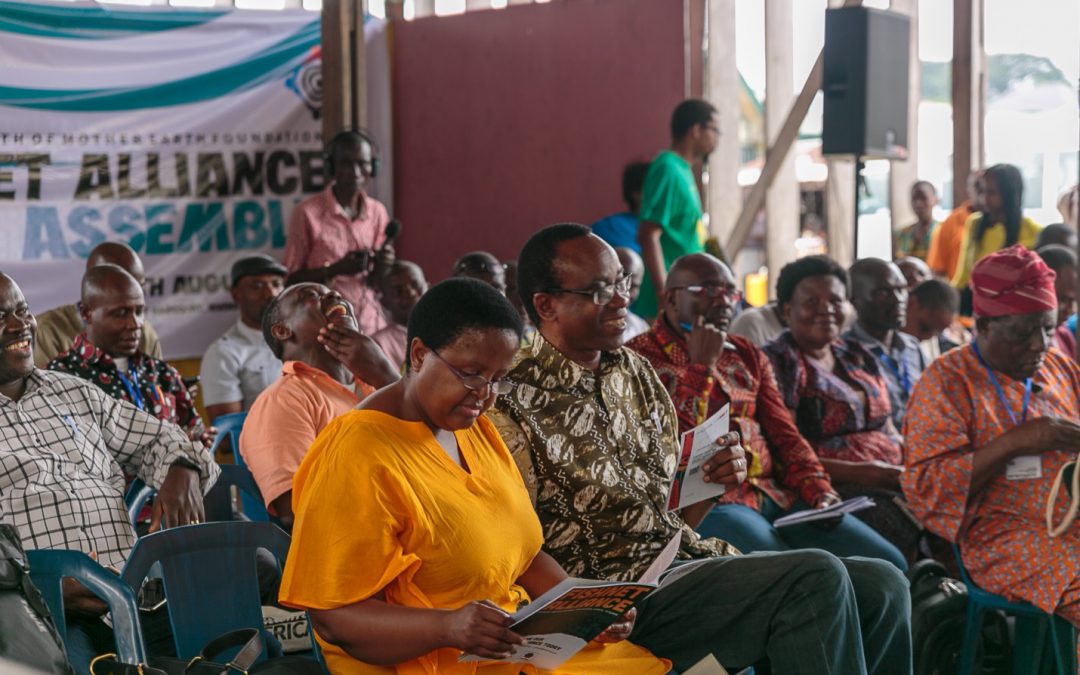
Health of Mother Earth Foundation (HOMEF) hosted the first Annual FishNet Alliance General Assembly with the aim of supporting and building grassroots power for enhanced coastal marine ecosystems monitoring and against the expansion of fossil fuels exploration and extraction in Africa.
This meeting held at Okrika water front, Port Harcourt, Nigeria on August 8, 2019. There were representatives from FishNet Alliance members from different states (Lagos, Akwa Ibom, Cross Rivers, Delta and Rivers States) in Nigeria.
It was also a time out for knowledge exchange and sharing on methods of fishing and the current predicaments of fishers as a result of extractive activities, between fishers from Nigeria and their counterparts in Cote D’Ivoire, Ghana, Senegal, South Africa and Togo.

Country Presentation
Togo
While sharing his experience, Abdou-Derman Adam Mouhamadou– a fisher and coordinator of FishNet Alliance in Togo, said he was very happy to see other fishers from other countries and Nigeria, reiterating and reinstating his commitment to the FishNet Alliance, while charging other participants that fishers need to come more together to fight a common course. Fishing is an occupation that generates income for community dwellers and revenue for the government. ”Hence this is our own economy. He called on fishers from all over Africa to rise to the challenges of the time and fight together, to make sure that the extractives are kept out of their water.
He noted that with the experiences he has gained through the Alliance, he has learnt to speak up for thousands of artisanal fishers in Togo and ensure that the rights to fishing as fishers are not neglected by those in political offices.
Togo, he said, has not started experiencing oil spills because oil has just been discovered in commercial quantities. He has learnt through a visit to oil impacted sited in Nigeria, there is need to stop the government from exploiting the oil. The launching of FishNet Alliance in Togo has led fishers to have a clear understanding of the urgent need to protect the marine ecosystem from the polluting activities of the extractive industry.
Ghana
Mike Abaka-Edu is a fisher and a marine mechanic in Ghana. In his presentation, he said that fish is a renewable resource, if it was not so, the oil industries would have killed everything and communities will have no fish at all. Fishing has been a generational occupation for community dwellers.
The data from the Ghana fisheries commission indicated that 10% of the Ghana population derives their livelihood from fishing because a lot of people living along the coastal belt are predominantly fishers; this is where we derive our food, our income, and wellbeing from fishing.
According to him, nowadays, when we go for fishing, we don’t get catch as it used to be except for the industrial trawlers and the Ghana maritime vessels that ply their trade in the ocean. Oil was discovered in Ghana in 2007and before that time, a lot of consultations were done without the involvement of fishers. Fishermen were not involved.
The environmental impact assessment conducted was without fisheries impact assessment. Whereas, the fisheries act of Ghana section 93 demands proponent to do fisheries impact assessment. We started experiencing difficulties in fishing until NGOs picked interest and began to help fishers fight for their rights. Beside the dwindling trend of fishes as a result of oil exploration, the destruction of our nets by their supply vessel also was major factor when oil exploration started.
Fishers were prevented from fishing around exploration areas because they say it is an international convention that you don’t fish close to exploration sites- exclusive sites that is 500m radius.
Oil exploitation started in commercial quantities 2010, and this gave rise to a plethora of problems. Some fishers have even died as a result of destruction of their canoes. In conclusion, he stated that there should be a halt to exploration and exploitation of oil for a while until proper legislative framework is in place to protect fishers from the exploration companies.
Senegal/Cote D’Ivoire
Lucie Tetegan, Chairperson for West African Association for the Development of Artisanal Fisheries (WADAF)and the coordinator of FishNet Alliance in Cote D’Ivoire/Senegal, in her presentation expressed her displeasure at the fact that industrial fishing grabs fishing space from artisanal fishers. She said in the past, nobody supports fishers but fishers have learnt through the hard way to organize themselves and speak up against injustice, oppression and discrimination from corporations. There has been the case where pollution from mining practices in Ghana polluted rivers in Cote D’Ivoire. According to her, the FishNet Alliance principles are in line with fishing sustainability and governance in waters.
In Senegal today, there are about ten thousand fishers belonging to different fishing associations, noting that traditional fishing knowledge/practices have been the best and hence must be promoted. Fishers should be projected and encourage to take part in participatory survey and management of the marine areas adding that in Sierra Leone fishers have been donated with a boat which they use to monitor their water ways- such can be replicated in other countries.
Fishermen/women should be shown how to manage the ecosystem. In Senegal, Oil exploration will start in 2022- she said after visiting oil impacted sites in Ogoni, Nigeria, she will work hard to educate fishers in Senegal and Cote D’Ivoire on the impact of oil extraction on the environment and fisheries and disabuse their minds about what the political leader are saying that oil extraction is good for the economy and will attract more money to the country. There is also the need to embark on advocacy to the decision makers.
Democratic Republic of Congo
Josue Mukura is a fisher and environmental campaigner based in the Democratic Republic of Congo (DRC) working to defend the rights of fishers, this organization consist of women who sell fish and equally involved in fishing.
According to him, Communities that are well-informed are stronger than others that are not informed; there is nothing to lose when the people are informed. Fishers should not be afraid of the oil companies but should be ready to speak up and take action when their rights are been trampled on and their waters polluted.
Local fishing creates employment to many people and add to the stability of the areas for sustainable development. In DRC, there is a lake that is shared by 5 countries. Together with their elites, fishers have put a strong resistance to an oil company that wanted to come and explore for oil- that led to their withdrawal.
However the problem has not gone away because the government has given concession blocks to the oil company. We are now educating people about the would-be impact of oil extraction in their communities. “We are going to revolutionize the mentality of our people” we have also filed a petition to put a moratorium to oil exploration in the country– he said.
Nigeria
Akintimehin Claudius Adewole: In Makoko, Lagos State, some fishers don’t go into the sea- only those with big boats can go into the high sea, because there is a very big lagoon that serves as fishing ground for the community fishers, he narrated that however, in this lagoon there are many problems to fishers.
One of the problem is government insensitivity to the plights of the fishers. For instance, part of the fishing areas have been dredged and sand-filled. This has led to the destruction of the marine environment and making fishing difficult.
Also, he lamented that fish nets are being destroyed by tug boats belonging to the owners of the dredgers in the little areas remaining in the lagoon. Plaque with a lot of problems, even when some fishing equipment are provided, the highly influential non-fishing political class highjacks them.
He posited that “Lagos State fishers need more sensitization and the government should also be made to understand that fishing is legitimate and fishers are stakeholder in the marine environment”.
Promise from Okrika waterfront, Rivers State: He noted that Oil exploration in Nigeria is age long and oil will not last forever, it is pertinent to begin to examine what life will be after oil; because it will end one day. Fishing is a primary occupation that will last a lifetime.
The river in Okrika waterfront was called the Prime Rose River; it empties into the Bonny river called Okorobatoru. According to him, he has been a local fisher for a long time- he decried the disappearance of marine life in the river, even the vegetation is destroyed. He noted that fish spun according to the layout of vegetation. Cultural and recreational activities that used to take place at our waterside no longer take place; we have also lost our natural mangroves and fishing grounds.
Oil spillages as a result of oil extraction has destroyed everything in the water- so fishing has no meaning anymore around here and so fishers are forced to the high sea where they are faced with sea pirates, security forces and other forms of restrictions.
Fishing is an occupation for both the men and women, young and old. While the men practice surface drift net pattern of fishing and bottom set net. The women practice the drag net method for catching crayfish, prawns …
He stated that FishNet Alliance members in Okrika are ready to ensure that the FishNet Alliance gain grounds and work to protect their water. The oil industries have not done the community any good they are prepared to mobilize other fishers to say no to oil and yes to fishing.
Ekong Inyang from Ibeno, Akwa Ibom State: Fishing in Akwa Ibom is for men and women, where the men go out to fish, the women help with the processing and even the children are also involved;” this makes fishing a way of life for our people”.
There are about 6 local government areas hosting fishing settlements in the state. He noted that the fish catch dropped since Mobil commenced oil exploration work in 1970 in their communities. This has even caused problems between fishers in their communities and neighboring African countries who previously allowed them to fish in their territorial water.
The spills from oil and gas facilities not only kill fish, it also destroys fishing nets. Expressing courage, faith and strength in the mandate of FishNet Alliance, he said “We are encouraged that with the coming together and support of members all over Africa, together we can hold these corporations to account”.
Recent Comments